Ethiopia Calls for Key Reforms at BRICS Summit
Diplomatic Corps Briefed on the upcoming Africa Climate Summit
NEWS IN BRIEF
Ethiopia
President Taye Atske Selassie bade farewell on Wednesday (July 9) to Ramiz Alakbarov, the outgoing UN Assistant Secretary-General and Resident and Humanitarian Coordinator in Ethiopia. The President commended him for his commitment and contributions during his time in the country.
President Taye attended Comoros’ 50th Independence Day celebrations on Sunday (July 6) and met with Comorian President Azali Assoumani on the sidelines of the Independence Day celebrations in Moroni.
He also attended the 90th anniversary of the Ethiopian Red Cross Society on Tuesday (June 8) at the Addis International Convention Center, urging the Society to build sustainable capacity to prevent and alleviate human suffering through timely humanitarian and development initiatives.
The 17th BRICS Summit took place in Rio de Janeiro on July 6 and 7, with Heads of State and Government of BRICS countries, partner countries, and leadership of outreach invitees in attendance. The summit saw high level deliberations on the topics of global peace and security, reform of multilateral institutions, climate finance, global health, and artificial intelligence. Prime Minister Abiy Ahmed had a successful participation in the summit, leading a high-level delegation consisting of cabinet ministers. (See article)
Members of the diplomatic community based in Addis Ababa were briefed on Wednesday (July 9) on the preparations for the Second Africa Climate Summit (ACS 2), scheduled to take place at the Addis International Convention Centre (AICC) from September 8-10, 2025. (See article)
Deputy Prime Minister Temesgen Tiruneh addressed the annual review of the National Migration Council on Saturday (July 5) in Addis Ababa, stressing the importance of effective migration governance to safeguard national security and uphold human rights.
Minister of Foreign Affairs Gedion Timotiwos reflected on discussions held with leaders of several countries on the sidelines of the 17th BRICS Summit on Monday (July 7) during an interview with an Ethiopian media outlet. He noted that the talks focused on strengthening diplomatic ties, expanding economic partnerships, and advancing shared development priorities.
The Ministry of Tourism, in partnership with the Information Network Security Administration (INSA), launched the “Visit Ethiopia” marketing website on Tuesday (July 8) in Addis Ababa to promote the country’s tourism destinations and services. The platform, unveiled by Tourism Minister Salamawit Kassa and INSA Director General Tigist Hamid, features a chatbot to assist visitors and connect tourism service providers.
State Minister of Foreign Affairs Ambassador Hadera Abera is taking part in the 47th Executive Council meeting of the African Union, being held in Malabo from July 10–11. On the sidelines, the State Minister held talks with Equatorial Guinea’s Foreign Minister Simeón Oyono Esono Angue and Rwanda’s Foreign Minister Olivier Nduhungirehe.
Ethiopia launched the Steering Committee for the National Coffee Platform on Wednesday (July 9) in Addis Ababa, bringing together stakeholders to strengthen one of the country’s most important economic and cultural sectors. State Minister of Finance and Committee Chairperson Semereta Sewasew acknowledged ongoing challenges such as climate change and market vulnerabilities while praising record export achievements.
Foreign Ministry Spokesperson Ambassador Nebiat Getachew, during a press briefing on Thursday (July 10), described the 2017 Ethiopian fiscal year as a year of successful diplomacy. Highlights included deepening international partnerships, promoting investment, supporting citizens abroad, and preparing to host major global summits on climate and development.
Kenya
President William Ruto honored former UN Secretary-General Ban Ki-moon with the country’s highest award, First Class: Chief of the Order of the Golden Heart (C.G.H.), on Tuesday (July 8) at State House, Nairobi. President Ruto praised Ban Ki-moon’s over 50-year public service career, highlighting his role in mobilising global action on the climate crisis, health, and gender equality
Somalia
Somalia’s Minister of Labour and Social Affairs Yusuf Mohamed met with Ethiopia’s Minister of Labour Muferihat Kamil on Wednesday (July 9) on the sidelines of the Third Africa Job Creation Forum. Their discussion focused on enhancing cooperation in employment, skills development, and improving labour market opportunities between the two countries.
South Sudan
The Minister of Foreign Affairs and International Cooperation of the Republic of South Sudan, Monday Semaya Kumba, arrived in Addis Ababa on Thursday (July 10) for a working visit. During his stay, the Minister is scheduled to meet with senior Ethiopian government officials to discuss ways to further strengthen bilateral relations between the two countries.
Africa and the African Union
The African Union (AU) opened the three-day Third African Job Creation Forum on Tuesday (July 8) in Addis Ababa, calling for bold action to tackle Africa’s youth employment crisis through industrialization and innovation. AU Commission Chairperson Mahmoud Ali Youssouf urged large-scale efforts to integrate Africa into global value chains and encouraged private sector engagement and youth-driven digital innovation. Ethiopia’s Deputy Prime Minister Temesgen Tiruneh emphasized youth as Africa’s strength and highlighted the AfCFTA as a path to shared prosperity.
Ethiopia Calls for Key Reforms at BRICS Summit
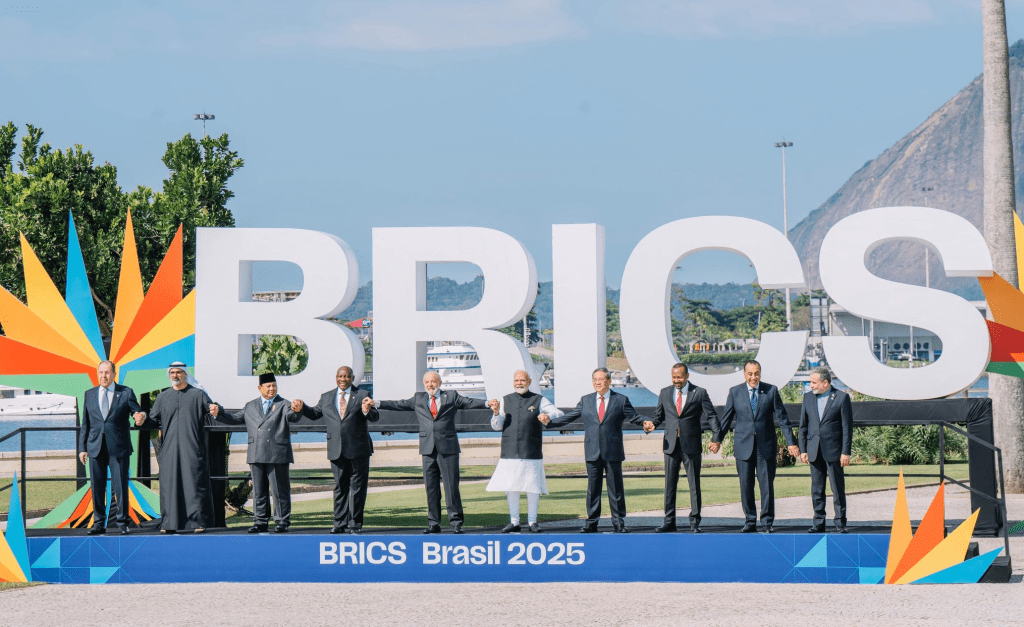
The 17th BRICS Summit took place in Rio de Janeiro on July 6 and 7, with Heads of State and Government of BRICS countries, partner countries, and leadership of outreach invitees in attendance. The summit saw high level deliberations on the topics of global peace and security, reform of multilateral institutions, climate finance, global health, and artificial intelligence. Prime Minister Abiy Ahmed had a successful participation in the summit, leading a high-level delegation consisting of cabinet ministers.
The Summit endorsed three Declarations, including the BRICS Leaders Declaration covering cooperation in the fields of economy and finance, people-to-people ties, and peace and security. The Declaration reaffirmed the commitment of BRICS countries to effective multilateralism centered on the United Nations.
Additionally, the Summit saw the adoption of outcome documents from the year-long negotiations, including the Leaders Statement on Global Governance of Artificial Intelligence and BRICS Leader’s Framework Declaration on Climate Finance. The Summit also endorsed BRICS Partnership for the Elimination of Socially Determined Diseases, based on the consensus reached among Health Ministers in June 2025.
Prime Minister Abiy underscored Ethiopia’s steadfastness in advocating for peace, driving economic transformation, embracing technology and innovation, and deepening regional integration. He recalled the need to reform global decision-making institutions, including multilateral financial institutions and the UN Security Council, to ensure equitable representation of developing countries, especially from Africa. He indicated BRICS countries should continue playing their aspirational role in order to advance peace, prosperity and collective security for the benefit of all.
At the high-level session dealing with “strengthening Multilateralism, Economic- Financial Affairs, and Artificial Intelligence” and involving BRICS partner countries and invitees of the outreach, Ethiopia underscored the urgent need to revamp development finance. Expressing its grave concern on the lack of implementation of the Addis Ababa Action Agenda and the inadequacy of the “Seville Compromise,” Ethiopia forewarned the regression in sustainable development could lead to security crises, social upheaval, public health emergencies, and irregular human mobility. It therefore called upon renewed efforts to innovate new tools for generating development and climate finance. It specifically stressed the critical need for a framework for debt management and treatment, including cancellation and suspension, and the exploration of tools such as debt-for-development swaps.
Regarding Artificial Intelligence (AI), Ethiopia urged BRICS countries to lead by example through intensified cooperation in human resource development, digital infrastructure, and AI governance. Delegations called on the need to adhere to the fundamental principles of international law, particularly respect for states’ sovereignty and implementation of ethical standards in the development and deployment of AI technologies.
At the High-Level Session on “Environment, COP 30, and Global Health”, Ethiopia urged for translating commitments into tangible actions for the benefit of nations most vulnerable to climate changes’ devastating impacts. In light of this, three key areas were highlighted – adequate and predictable financial resources, revamping energy development in Africa, and urgent action against environmental degradation. Ethiopia specifically highlighted its Green Legacy Initiative as a practical contribution to addressing global warming, food insecurity, and environmental degradation, urging global attention and support for such efforts. Furthermore, Ethiopia called for enhanced local and regional production capacity for essential health goods and services to guarantee equitable and timely access to medicines, vaccines, and other medical products.
In addition to the high-level deliberations, BRICS Business Council, Women Business Alliance, Civil Council, and the New Development Bank presented their activity reports.
The 17th BRICS Leaders’ Summit was preceded by the third Meeting of BRICS Sherpas and Sous Sherpas, held from June 30 to July 5. Consensus was reached on numerous issues of global importance, including the topics Ethiopia introduced. These topics are the need to grant enhanced support for African Union peace operations, BRICS support for Ethiopia’s WTO membership, commitment of BRICS to support the United Nations to discharge its mandate, especially in light of the contemporary political and financial challenges it faces, expedited consideration of BRICS countries’ membership to the New Development Bank, and sustainable debt management mechanisms among developing countries. BRICS also expressed unified support for the 2025 theme of the African Union, “Justice for Africans and People of African Descent Through Reparations,” and a commitment to the protection of Genetic Resources, and Associated Traditional Knowledge.
The Summit saw the participation of more than thirty Heads of State and Government, and leaders of regional and international organizations. Among the prominent attendees were the United Nations Secretary-General, the Chairperson of the African Union, the Director-General of the World Trade Organization, and Leaders of other influential regional and international bodies.
Diplomatic Corps Briefed on the upcoming Africa Climate Summit
Members of the diplomatic community based in Addis Ababa were briefed on Wednesday (July 9) on the preparations for the Second Africa Climate Summit (ACS 2), scheduled to take place at the Addis International Convention Centre (AICC) from September 8-10, 2025.
In his opening remarks, FM Gedion Timothewos stated that the Climate Summit is an expression of our collective determination to address the climate crisis that threatens our future. Ethiopia, through the Climate Resilient Green Economy Facility and the Green Legacy Initiative, is significantly contributing to effecting tangible results in combating climate change, he said. He further stated that climate financing, innovative partnerships, and green investments, among others, lead to concrete, actionable results that benefit Africa and the rest of the world. The Summit, in this regard, Gedion added, serves as a critical platform to leverage our collective capacity to address compounded challenges borne out of climate change.
Minister of Planning and Development Fitsum Assefa, for her part, provided highlights of the preparations for the historic summit. She stressed the fact that this year’s ACS, unlike its previous variants, will focus on advocating innovative and nature-based solutions while enhancing coordination, accelerating climate action, and amplifying Africa’s priorities on the global stage. The Summit, she noted, particularly addresses the urgent need for robust climate finance, as Africa faces disproportionate climate impacts despite its minimal greenhouse gas contributions. Ethiopia, with its proven commitment through initiatives like the Green Legacy Initiative, demonstrates African-led solutions for a resilient and sustainable future.
Senior Environment and Climate Change Policy Expert, Abas Mohammed, also gave the participants an in-depth presentation on the particulars of the preparations for the Summit.
Themed “Accelerating Global Climate Solutions: Financing for Africa’s Resilient and Green Development” and co-hosted by the Ministries of Planning and Development and Foreign Affairs and the African Union Commission, ACS 2 will bring together approximately 25,000 participants, thereby creating a definitive platform to galvanize unified action and accelerate the journey towards a prosperous, climate-resilient continent.
The Summit will focus on three key thematic areas in its deliberations: harnessing Africa’s natural capital and technological innovations to drive green growth; strengthening the continent’s resilience to climate impacts by integrating scientific knowledge and nature-based approaches; and unlocking capital while elevating homegrown innovation.

Leave Your Comments Here